Low-speed, high-torque twin-shafts, configurable cutting chambers, and a range that covers the full range of power and production capacity needed on the job site: how to choose between the CONDOR, COBRA, and CAYMAN — plus the LCM electric solution.
For over thirty years, CAMEC has been designing and building turnkey waste treatment and recycling systems. Their mobile shredders take that same engineering to the next level: autonomous machines, designed and built entirely in Italy, designed to ensure the same operational continuity and quality as a fixed line wherever needed—on construction sites, in storage areas, and wherever the volumes are located. The range covers the entire operational spectrum with three twin-shaft shredders—the CONDOR 1500, the COBRA 1800 in hooklift and tracked versions, and the CAYMAN 2400—plus the LCM 520 electric shredder. This guide explains the technologies common to the range and the criteria for choosing the right model.
What technologies do CAMEC mobile shredders have in common?
The underlying engineering choices are consistent across the entire range, and address one goal: continuous operation with controlled operating costs.
In detail:
-
Low-speed, high-torque dual shaft: slow rotation reduces vibration, noise, and wear on the cutting tools, while high torque, up to 220,000 Nm on the COBRA 1800, ensures cutting force even on the toughest materials.
-
Integrated protection against crushable objects. When the machine encounters an unprocessable foreign object, the protection systems automatically intervene by reversing the shafts or intercepting the object, protecting the tools and transmission.
-
Configurable cutting chambers and tools: interchangeable shaft configurations and cutting systems adapt the same machine to different materials and sizes: this is the topic of customization, which we will explore in detail in a dedicated article.
-
Heavy-duty structure and wear-resistant components: frames and components sized for continuous on-site operation, with direct access points to critical components for quick and safe maintenance.
-
Single-operator operation: full remote control, preset work programs for each material, and remote diagnostics. The machine arrives, positions itself, and works.
What criteria guide the choice of the model?
Five variables guide the choice, in order of importance:
-
The material to be treated and the required output size: this is the criterion that determines the configuration of the cutting chamber even before the model.
-
The required hourly productivity: tons/hour are the unit of measurement that scales the investment relative to the actual volumes to be disposed of.
-
The required mobility: a hook-lift configuration for those moving the machine between sites on a tractor, or a tracked configuration for those moving within the construction site, towards the pile.
-
Site space and logistics: dimensions, handling, power supply with a spider or shovel.
-
Power supply: all models in the shredder range are equipped with a Stage V-approved diesel engine. Where the construction site imposes restrictions on diesel, the answer is the LCM 520 electric shredder.
Let's see how the models cover this range of choices.
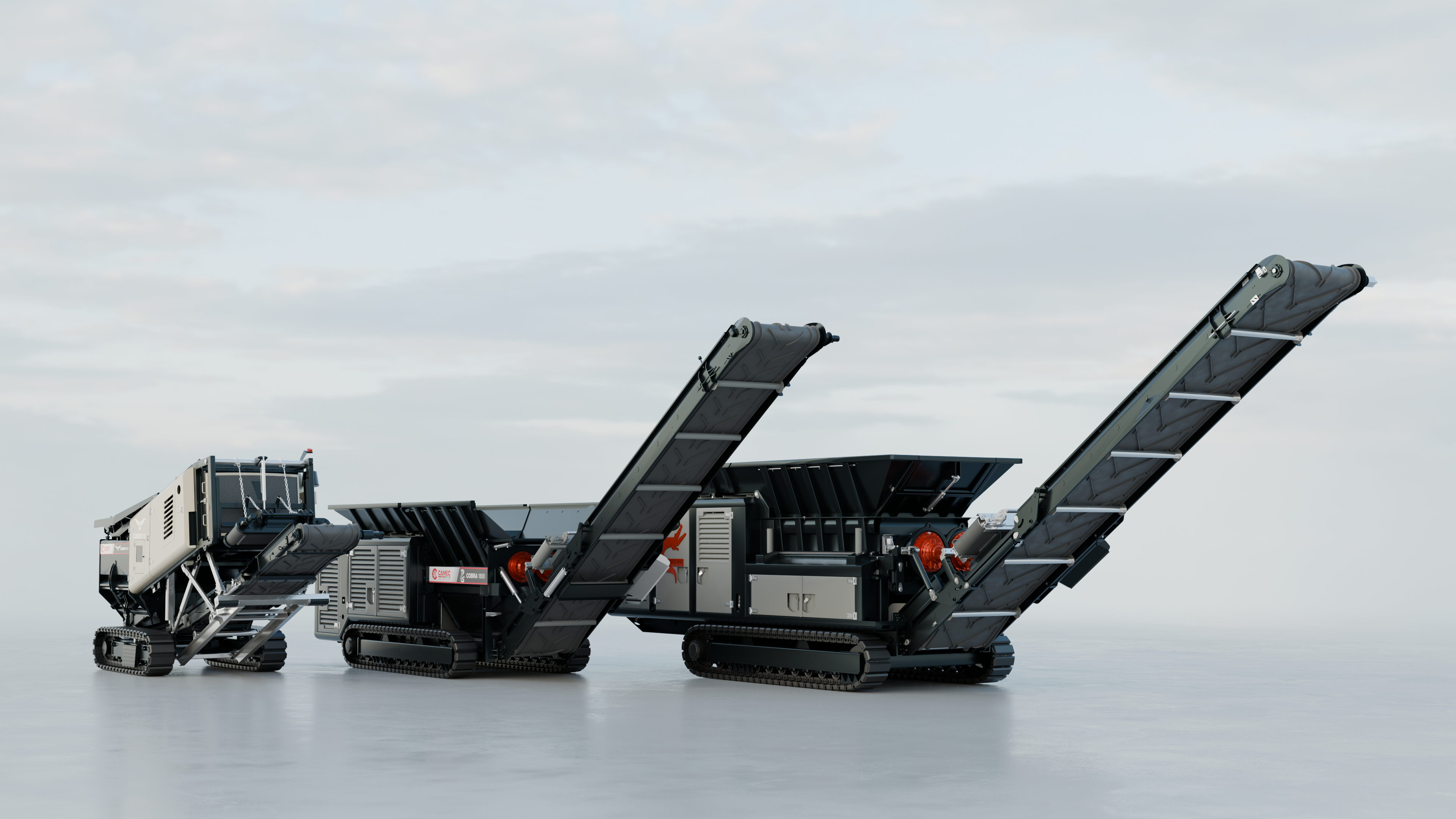 Caption: The complete line of CAMEC mobile shredders. From left: CONDOR 1500, COBRA 1800/C, CAYMAN 2400
CONDOR 1500: robust, compact, versatile
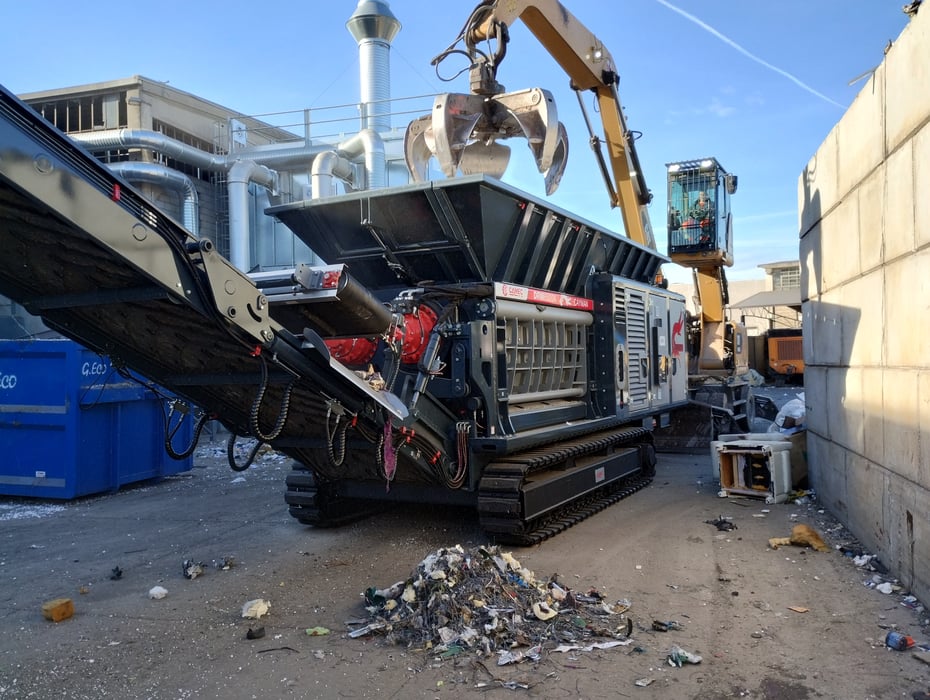
It's a versatile machine: up to 175 kW, 1,500 mm shafts with synchronous and asynchronous operation, torque up to 160,000 Nm, a weight of approximately 15,000 kg, and low fuel consumption (20–25 l/h). Four quick-change shaft configurations—mixed materials, wood, light metals, WEEE—and adjustable side combs to balance size and speed make it suitable for construction sites with constantly changing material. It comes standard with both hooklift and tracked versions, and the hydraulically lowerable chassis facilitates transport.
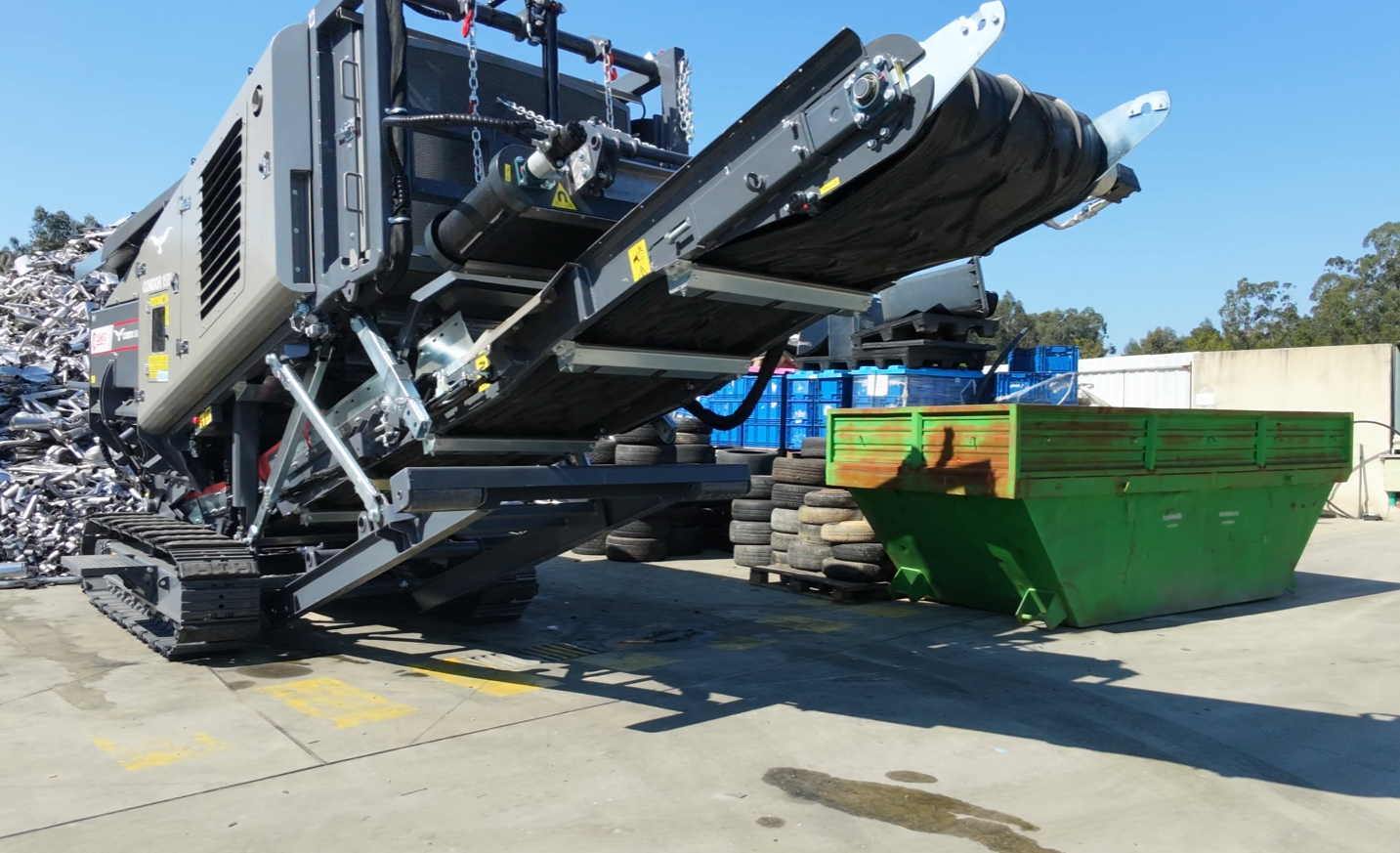 Caption: CMEC Condor 1500 mobile shredder
| Material | Indicative capacity (t/h) |
| Wood scraps / pallets | 15-25 |
| Biomass, prunings and branches | 20-25 |
| Paper and cardboard | 8-15 |
| Plastic | 10-20 |
| RAEE R2 | 10-15 |
| RSU | 5-15 |
| Bulky items | 5-15 |
| Industrial solid waste | 5-15 |
| Light ferrous scrap | 15-20 |
| Light aluminum scrap | 10-15 |
| Used rubber and tires | 5-10 |
Indicative values only: actual capacity varies depending on the type and characteristics of the material (humidity, contaminants, starting size). Cutting chamber configuration, operating conditions, loading method, and cutting tool wear are also important factors. For an accurate estimate for your material, contact CAMEC technicians.
COBRA 1800: power and compactness, in two versions
This is the flagship model in the range for continuous mixed flow production, offering a perfect balance of power and compactness. The 1,100 x 1,800 mm cutting chamber and shredding system are identical in both versions: the only difference is mobility.
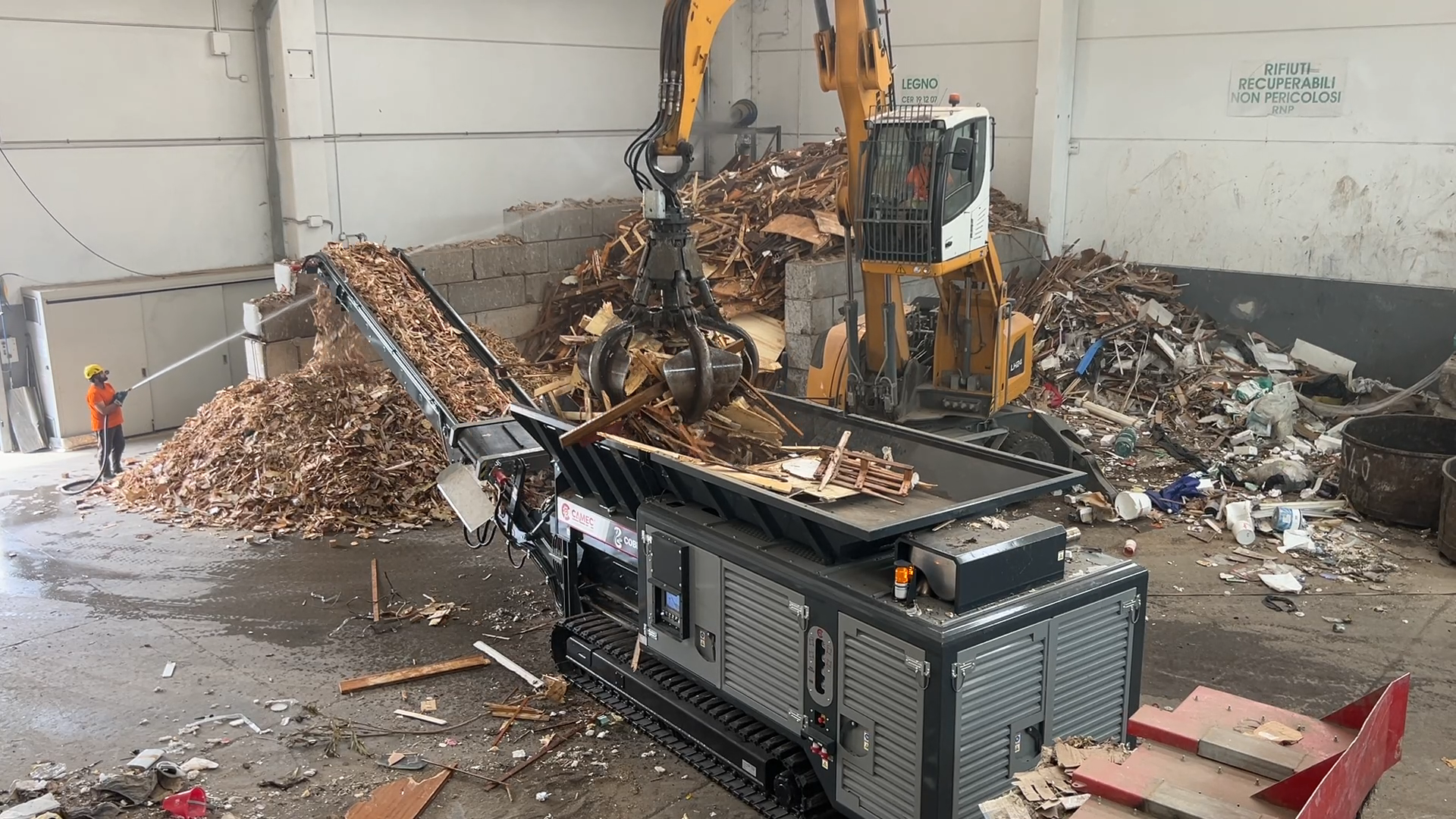 Caption: CAMEC Cobra 1800 mobile shredder
| Specification |
COBRA 1800 S - hook lift | COBRA 1800 C - crawler |
| Diesel Engine (Stage V) | 294 kW Scania | 294 kW Scania |
| Cutting chamber | 1.100 × 1.800 mm | 1.100 × 1.800 mm |
| Maximum torque | 220.000 Nm | 220.000 Nm |
| Hopper | 5 m³ bipartite, hydraulic tailgate | 5 m³ bipartite, hydraulic tailgate |
| Magnetic separator | As standard | As standard |
| Final size | ≤ 350 mm | ≤ 350 mm |
| Weight | 17.500 kg | 21.500 kg |
The adjustable cross-cutting bar allows for calibrated sizes; four interchangeable cutting configurations cover everything from pre-shredding to controlled sizing.
The approximate processing capacities of the COBRA 1800:
| Material | Indicative capacity (t/h) |
| Wood scraps / pallets | 25-35 |
| Biomass, prunings and branches | 20-30 |
| Paper reels | 5-10 |
| Plastic | 10-20 |
| Aluminum / PVC profiles | 10-20 |
| RSU | 25-35 |
| Bulky items | 25-35 |
| Industrial waste | 20-30 |
| Mattresses | 10-15 |
| Light ferrous scrap | 15-25 |
| Light aluminum scrap | 15-20 |
| Tires | 15-20 |
Indicative values only: actual capacity varies depending on the type and characteristics of the material (humidity, contaminants, starting size). Cutting chamber configuration, operating conditions, loading method, and cutting tool wear are also important factors. For an accurate estimate for your material, contact CAMEC technicians.
CAYMAN 2400: the most powerful of the series
The top-of-the-line model is designed and built for high volumes: a 566 kW Scania engine (EU Stage V), a 2,350 x 1,600 mm working chamber, independently rotating asynchronous shafts from 15 to 40 rpm, and three interchangeable cutting systems. The self-propelled tracked chassis, retractable 1,200 mm extractor belt, and hydraulically adjustable magnetic separator make it a complete reduction and primary separation platform, which can be combined with a classifying screen. Intelligent PLC-managed load control adjusts rotation to the material and automatically reverses the shafts in the event of overload.
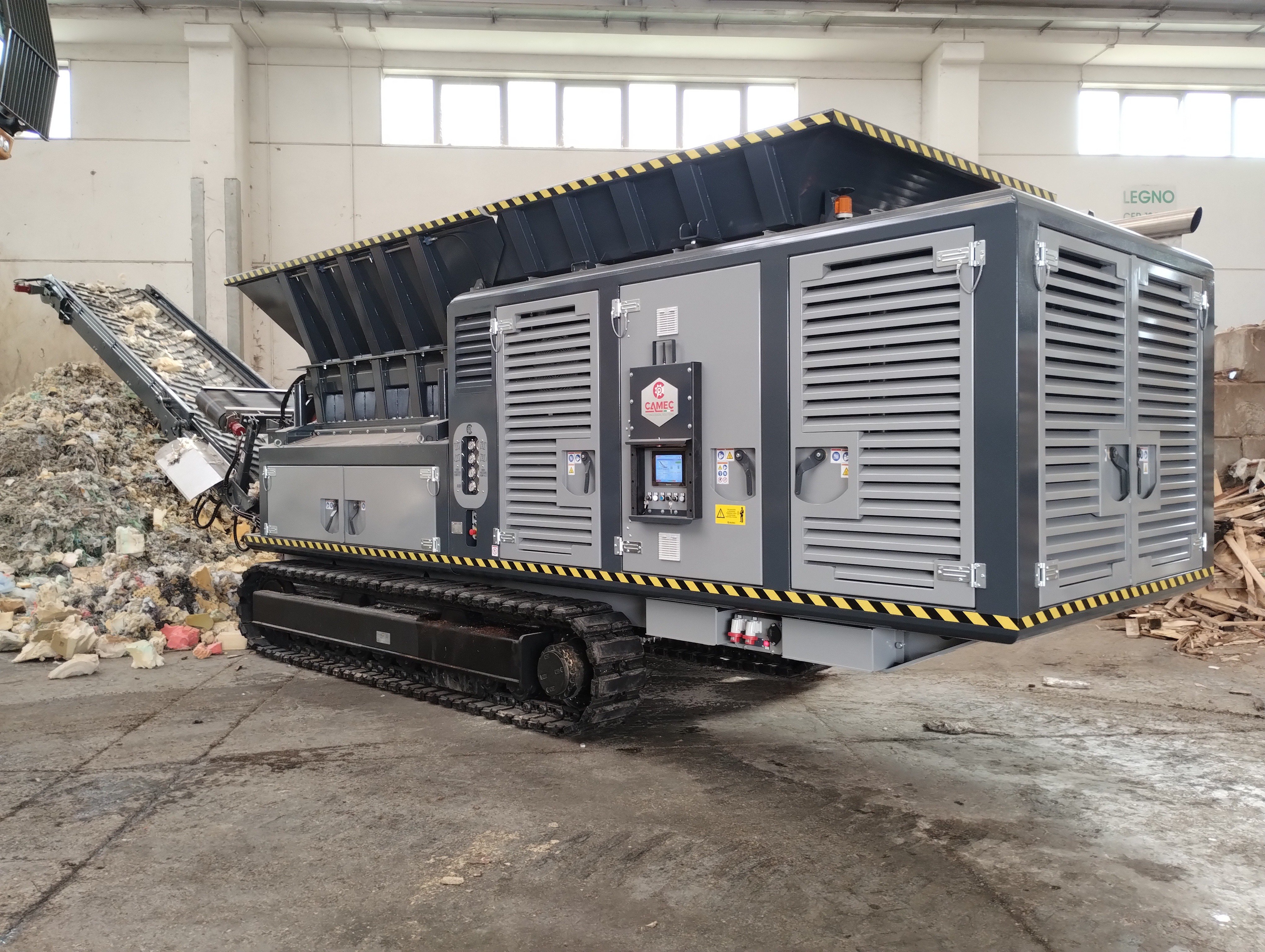 Caption: CAMEC Cayman 2400 mobile shredder
| Parameter | Valore |
| Motor | 566 kW Scania Diesel — EU Stage V |
| Transmission | Bosch Rexroth / Linde hydraulic motors, with Bonfiglioli gearboxes |
| Work room | 2.350 × 1.600 mm |
| Tree length | 2,350 mm — Ø 650–790 mm depending on configuration |
| Shaft speed | 15 – 40 rpm, depending on cutting chamber configuration |
| Hopper | 6 m³ — hydraulically tiltable |
| Extractor belt | 1,200 mm / 100 m/min — hydraulically retractable |
| Size | ≤ 350 mm, depending on the cutting chamber configuration |
| Fuel tank | indicative 800 l |
| Weight | 39.000 kg |
| Closed footprint | 4.260 × 2.550 × H 1.440 mm |
| Open footprint | 13.280 × 2.800 × H 3.500 mm |
| Mobility | Self-propelled tracked vehicle |
The indicative processing capacities of the CAYMAN 2400:
| Material | Indicative capacity (t/h) |
| Wood scraps | 35–60 |
| Prunings and branches | 25–45 |
| Paper reels | 20 |
| PVC profiles | 20–25 |
| RSU | 50–70 |
| Bulky items | 50–70 |
| Industrial waste | 35–45 |
| Mattresses | 25–35 |
| Light ferrous scrap | 50–80 |
| Aluminum | 25–35 |
| Tires (ELT) | 25–30 |
| Car bodies cleaned up | 50–70 |
Indicative values only: actual capacity varies with material type and characteristics (moisture, contaminants, starting size), cutting chamber configuration, operating conditions, loading method, and cutting tool wear. For an accurate estimate for your material, contact CAMEC technicians.
And when the construction site requires electric? LCM 520
The LCM 520 completes the range with a different solution: it's not a shredder, but a twin-shaft crusher with a 135 kW electric power supply, designed to open bags and pressed bales before sorting. Where diesel or noise restrictions rule out internal combustion machines, it operates with maximum silence and zero local emissions.
Which mobile shredder should I choose?
The range orientation map:
| Model | Usage profile | Strong point |
| CONDOR 1500 | Variable worksites and flows, difficult materials, and the need for versatility | Universality: 4 quick-change shaft configurations |
| COBRA 1800 S / C | Continuous production on mixed flows with controlled size | Power/compactness balance; interchangeable chamber; choice of tracked or demountable |
| CAYMAN 2400 | High volumes and demanding materials | Maximum productivity of the range; chamber 2,350x1,600 mm |
| LCM 520 (laceratore) | Opening bags and bales in contexts with diesel restrictions | Electric power supply: silent and zero local emissions |
The full operational comparison—shreddable materials and tons/hour by product line—is the subject of a future article in this series.
Frequently Asked Questions
Want to find the right model for your material?
CAMEC technicians are available to evaluate the materials, volumes, and logistics of your construction site and configure the most suitable machine. Contact the CAMEC team for personalized technical advice.
