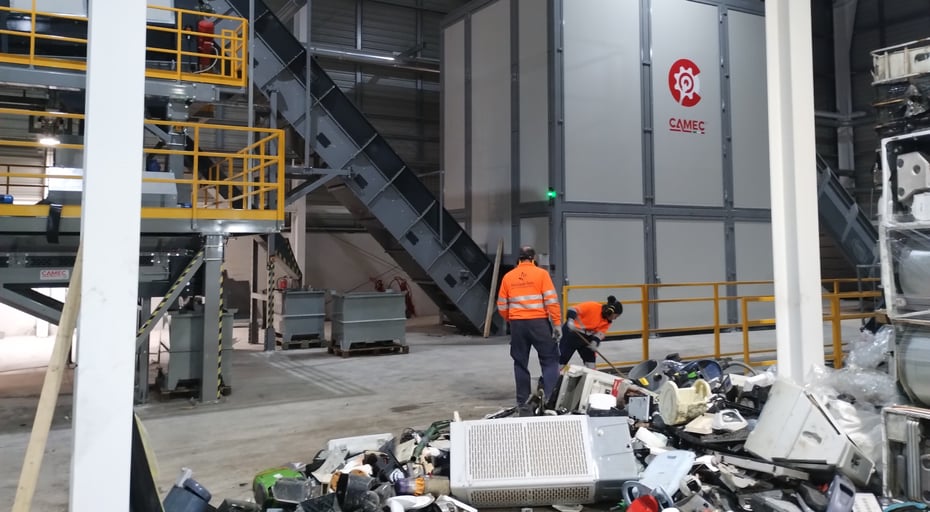
WEEE (Waste Electrical and Electronic Equipment) management represents one of the primary industrial challenges in Europe today. Increasing volumes, the complexity of waste streams, and increasingly stringent regulations require high-performance WEEE treatment plants designed to guarantee safety, operational continuity, and the quality of recovered fractions.
Against this backdrop, the new CAMEC WEEE plant in Spain stands out: a modular and scalable line designed for the treatment of mixed electronic waste that combines engineering efficiency, operational flexibility, and compliance with European regulations.
Features of the New WEEE Plant in Spain and Project Objectives
Client Requirements
The Spanish client requested an industrial solution from the CAMEC team capable of:
- Treating mixed WEEE with variable compositions;
- Ensuring operator safety and dust control;
- Obtaining high-quality recovered fractions;
- Integrating a scalable and modular line, adaptable to future capacity increases;
- Fully complying with European WEEE and RoHS directives.
These needs are typical for medium and large-scale WEEE operators in Europe, who must balance productivity, compliance, and a high level of material recovery.
Performance Objectives
The line deliberately avoids thermal or chemical processes, adopting an entirely mechanical treatment, a solution currently considered best practice in the European WEEE sector.
The technical objectives of the plant were defined to meet the needs of modern industrial WEEE plants, focusing on:
- Modulable production capacity, adaptable to different line configurations and input material characteristics;
- Significant volume reduction, essential for optimizing subsequent separation and recovery phases;
- High quality of recovered metal fractions, suitable for re-insertion into industrial cycles;
- Integration of dust extraction and filtration systems, to protect the working environment and comply with current regulations.
Overall, the plant's design approach is in line with the best practices adopted in European WEEE plants, both in terms of performance and operational reliability.
Line Structure and Integrated CAMEC Machinery
The new CAMEC WEEE plant in Spain is designed according to a step-by-step logic that maximizes material liberation and separation precision.
Main Sections of the Line
- WEEE Loading Unit
Constant and controlled feeding of electronic waste for subsequent treatment phases. - Manual Pre-selection
Ergonomic stations for the preventive removal of critical components (batteries, capacitors, displays, glass), in line with WEEE safety best practices. - Primary Shredding – CAMEC Twin-Shaft Shredder
Stable and controlled volume reduction, ideal for heterogeneous WEEE. The twin-shaft system ensures process continuity and mechanical protection. - Secondary Grinding – Horizontal Hammer Mill
A key phase for the liberation of metal and plastic fractions, an essential step to increase the effectiveness of subsequent separations. - Magnetic Separation of Ferrous Metals
Efficient recovery of steel and ferrous metals. - Screening – 3-Outlet Trommel (10 / 25 / 45 mm)
Particle size classification of the shredded material, indispensable for increasing separation precision. - Non-Ferrous Separation – Eddy Current Separator
Recovery of aluminum and copper via induced currents, the standard reference technology in industrial WEEE recycling. - Optical Sorting
Advanced separation of plastics and mixed materials to improve the quality of recovered fractions. - Extraction and Filtration System
Control of fine dust and protection of the work environment, a fundamental requirement in modern WEEE plants.
.png?width=1200&length=1200&name=ChatGPT%20Image%203%20feb%202026%2c%2008_31_45%20(1).png)

CAMEC Models for Maximum Effectiveness in WEEE Treatment
Twin-Shaft Shredding: Reliability and Control
In WEEE treatment, primary shredding is a critical phase. Choosing a CAMEC twin-shaft shredder allows for:
- Managing variable inputs without overloads;
- Obtaining homogeneous fragmentation;
- Reducing wear and machine downtime.
Hammer Mill: Fraction Liberation
The hammer mill is fundamental for effectively separating metals and plastics. Its use is recognized as an industrial standard in modern European WEEE plants.
Trommel, Eddy Current, and Optical Sorting: Final Quality
The combination of particle size screening, magnetic and non-ferrous separation, and advanced optical sorting allows for purity levels exceeding 98%, a requirement currently demanded by the end markets for secondary raw materials.
A Plant That Guarantees Concrete Competitive Advantages
Compared to less evolved WEEE solutions, the new CAMEC plant commissioned in Spain offers:
- Greater operational flexibility;
- Consistent quality of recovered fractions;
- Integration with automation and traceability systems;
- Compliance with current and future European regulations;
- The possibility to scale capacity without redesigning the entire line.
A WEEE Solution Looking Towards the European Market
The new CAMEC WEEE plant in Spain represents a concrete example of engineering applied to WEEE recycling, designed for operators who want to invest in reliable, high-performance plants compliant with national and European regulations. It is an industrial platform designed not only to meet current needs but to support the growth of the European WEEE market in the near future.
Do you want to build a new WEEE plant in Spain or Europe? CAMEC designs and manufactures modular WEEE lines from 1.5 to 6 t/h, featuring advanced metal and plastic separation, dust control, and industrial automation.