
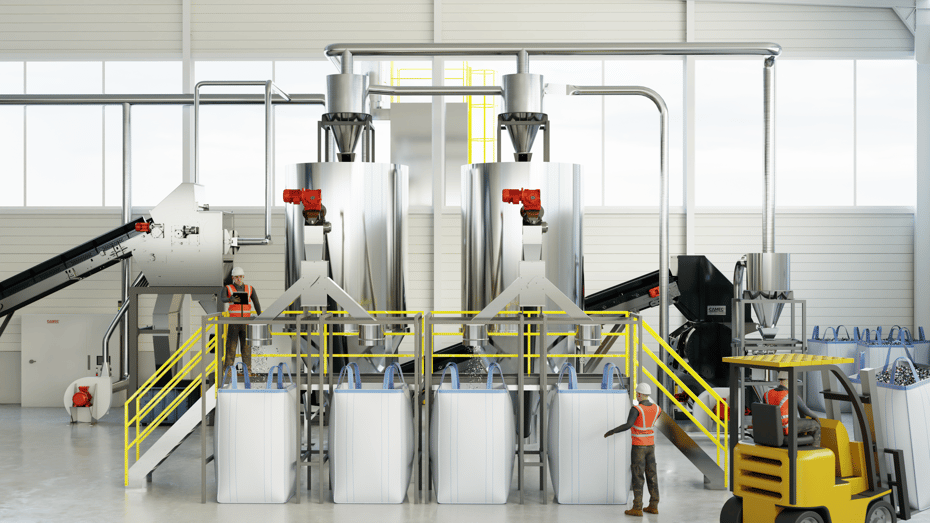
In the journey toward more sustainable industrial models, the treatment and recovery of plastic waste represent a central challenge for the circular economy. Within this context lies the initiative developed by CAMEC in the United Arab Emirates. The project, which led to the creation of a shredding and dry-washing plant for B&A, stands as a virtuous circular economy initiative based on closing the plastic waste cycle within the country.
The plant was developed for B&A—a joint venture between Beeah Group and Greenthesis—as part of a project focused on the recovery of plastic waste within the UAE.
The realization of the plant is the result of a collaboration between CAMEC and GCB Polymers, the technical partner of the project, who contributed to the engineering and technological configuration of the line. The industrial manufacturing and the supply of the turnkey plant were managed by CAMEC.
A local-loop circular economy initiative
The project serves as a concrete example of the circular economy applied to plastic waste recovery in the United Arab Emirates. The process was designed to develop and close entirely within the country, creating a local loop capable of reducing dependence on external supply chains and generating industrial value locally.
This approach meets the needs of a rapidly evolving market where sustainability, industrial autonomy, and technological innovation are increasingly strategic elements.
The rigid plastic shredding and upcycling plant
The shredding and recovery plant for rigid plastics was designed and engineered in close collaboration between CAMEC and GCB Polymers and industrially manufactured by CAMEC with a "turnkey" approach. This was done to meet the client's requirements for high performance, operational reliability, and consistent quality of the recycled material.
Thanks to advanced engineering and the integration of technologies dedicated to shredding, separation, and granulation, the system ensures an efficient, highly automated, and constantly monitored process. Every stage of treatment is optimized to ensure the production of a clean, homogeneous, and ready-to-use recycled granule, while reducing waste and energy consumption to keep overall operating costs low.
The high level of automation, combined with the flexibility of the production line, allows for the processing of a wide range of rigid plastics—including mixed or contaminated fractions—while maintaining high and stable quality standards over time.
.png?width=1200&length=1200&name=1%20(1).png)
.png?width=1200&length=1200&name=2%20(1).png)
Clean and ready-to-use granules: the treatment process
The treatment process is designed to transform rigid plastic waste into clean, ready-to-use recycled granules through an automated and constantly controlled flow. The material undergoes primary shredding and, once ground, moves to the removal of metallic contaminants via magnetic separation and metal detectors.
Subsequent stages of secondary shredding, air separation, and cleaning allow for the elimination of residual impurities and prepare the material for granulation—the phase where the plastic is transformed into uniform and consistent granules. These granules are then dedusted, transported, and stored in silos, ready for packaging or direct use in industrial applications.
Finally, an advanced dust extraction and filtration system completes the plant, ensuring the quality of the final product as well as a safe and controlled working environment.
A shared commitment to developing a plastic upcycling model
The project completed for B&A represents a tangible example of how industrial collaboration, technological expertise, and plant engineering can contribute to the development of circular economy models applied to plastic waste treatment.
In this context, CAMEC confirms its role as a technological partner for the construction of waste recovery plants, operating in synergy with technical partners and industrial operators active in the most dynamic markets.
.jpeg?width=1600&height=1066&name=WhatsApp%20Image%202026-01-14%20at%2011.39.13%20(1).jpeg)
A concrete example of the circular economy applied to plastic treatment, developed entirely in the United Arab Emirates.